After the Monument: Rethinking Italian American Identity Through Art
Author’s note: This essay stems in part from a long conversation with Joseph Sciorra—a folklorist, historian of Italian American culture, and Director of Academic and Cultural Programs at the John D. Calandra Italian American Institute. Sciorra passed away suddenly on October 5, just days after our conversation and a week before Columbus Day. For decades, his research helped interpret Italian American culture through the lenses of everyday practices, memory, labor, popular culture, and forms of cultural production. For me Joe was a touchstone whenever I addressed topics related to Italian American culture, and his reflections on the diaspora and the construction of identity run through many of the pages that follow. I am publishing this text in his memory as well, and with the intention of revisiting his research in the future in future issues of The Pollinator.
————————————
On October 12, the United States celebrates Columbus Day, an occasion that for decades served as a key moment for the public visibility of Italian-American identity. Today, that central role is increasingly being challenged. After all, diasporic identities rarely remain unchanged: they undergo changes in language, symbols, customs, and social standing; they preserve some practices, abandon others, and transform still others. In the case of Italian-Americans, this process has produced a culture that is both recognizable and difficult to define—distinct enough to continue asserting its own unique character, yet integrated enough into American society to have to reckon with the implications of that integration.
Christopher Columbus is where this tension becomes most visible. For generations, his figure provided a shared symbol of pride and public recognition, but his arrival in the Americas also marks the beginning of a process of colonization, dispossession, and violence against Indigenous peoples. Consequently, Indigenous Peoples’ Day has emerged alongside Columbus Day celebrations and, increasingly, challenges to Columbus’s legacy are arising from within the Italian-American community itself.
The crisis surrounding that symbol brings to light tensions that have long run through Italian-American identity: the memory of discrimination and the entry into “whiteness,” the growing distance from the immigrant experience, and the relationship between cultural preservation and cultural production. These tensions resurface today in family memories and in the ways Italian Americanness is represented and transformed. They also emerge in the practices of many artists who reflect on these themes and their own identities through forms of making that rework the very materials constituting that Italian-American identity.
These issues also concern what happens to a culture when it moves. Italian immigrants arriving in the United States brought with them dialects, artisanal skills, domestic practices, religion, food, and forms of work and patterns of social life deeply rooted in their places of origin. In the United States, that heritage encountered different social hierarchies, cultural models, and conflicts. Some practices were lost, others were adapted and some became ethnic markers or stereotypes; still others continue to resurface in cultural production to this day.
What happens to a culture when it crosses into another place, encounters new social dynamics and languages, retains part of its past, and creates something that did not previously exist—this lies at the heart of The Pollinator. It is what I call “geoculture.” That is why, on the occasion of Columbus Day / Indigenous Peoples’ Day, I wanted to devote an essay to Italian American art, expanding on a shorter article published in Il Giornale dell’Arte. After all, Columbus, too, belongs to this history of transformation and to the cultural processes through which societies make themselves legible to the outside world.
Entering Whiteness
Joseph Sciorra, a folklorist and scholar of Italian American culture who served as Director of Academic and Cultural Programs at the John D. Calandra Italian American Institute, spent years studying, together with Laura E. Ruberto, the construction of Columbus as an Italian American symbol. Their research challenges the idea that Italian immigrants arrived in the United States with a particular identification with the navigator. Columbus already belonged to the American national imagination; his appropriation as an Italian ethnic hero came later and was championed primarily by figures with economic, cultural, and political capital.
“The primary promoters of Columbus as an Italian ethnic hero were not working-class immigrants,” Sciorra explained, “but rather figures who possessed the cultural and financial capital to act as intermediaries between Anglo-American elites and the working masses, aiming to mitigate the discrimination the latter faced. The embrace of Columbus was a much more top-down story than it is usually acknowledged. Columbus thus also offered a form of recognition within American society. And this is where the history of the symbol intersects with the history of whiteness. For Sciorra, accepting Columbus as an American emblem also accompanied Italian Americans’ gradual entry into a racial category that, at the time of mass migration, was by no means assured. Their position had long been ambiguous and contextual; over the course of the twentieth century, that changed. “Those who continue to champion Columbus as an Italian-American symbol conveniently erase the issue of race from the conversation,” Sciorra told me. The narrative of assimilation frequently invokes the idea that “we worked hard, pulled ourselves up by our bootstraps, and that is why we succeeded.” What gets left out, he noted, is “white privilege—the opportunity to enter into whiteness and acquire its privileges.”
The memory of discrimination and the acquisition of those privileges do not cancel each other out. They belong to different moments in the same history. It is precisely their coexistence that complicates any contemporary assertion of Italian-American identity based solely on the experience of exclusion.
Artist John Avelluto makes a similar point: “Of course we faced discrimination, but we had our whiteness, our complexion, to escape within, and I believe that changes everything.” Markers of ethnicity could become less visible. “If we didn’t wear the symbols of our ethnicity, others wouldn’t know. We’d put on a suit and move forward.” That ability to change one’s attire—both literally and symbolically—distinguishes the Italian-American experience from that of communities upon whom racialization continues to operate regardless of economic or cultural assimilation. Avelluto is very clear on this point: he refuses to draw an equivalence between the discrimination Italians experienced historically and the structural racism experienced by other groups.
Today, there is no need to dwell on narratives of discrimination and poverty to construct an Italian-American identity. Art can provide a way to think about cultural specificity, beyond both victimhood and chauvinism.
Stereotypes Changing Hands
Avelluto grew up in Brooklyn, in a historically Italian-heavy neighborhood, surrounded by a repertoire of instantly recognizable images: food, gestures, language, the concepts of “bella figura” and “brutta figura”, and caricatures of the Italian-American as loud, excessive, mafioso, and provincial. Today, he incorporates those images into his work, treating them with affection, irony, and a certain measure of undisguised unease.
The very stereotypes Avelluto challenges in his own work are at the center of Gavones, an exhibition he curated opening October 15 at the Calandra Institute. The title comes from an Italian American distortion of cafone, referring to someone boorish and excessive, especially around food. For generations, Italian-Americans sought to distance themselves from precisely that kind of portrayal; today, Avelluto observes, “we are in a moment of reclamation.” The gavone can end up on a T-shirt. Food that once marked otherness becomes material for painting, sculpture, installation, and performance. The caricature circulates on Instagram and TikTok as a form of self-representation. What was once a source of embarrassment, of brutta figura, becomes an aesthetic.
This shift in meaning also extends to symbols that have traveled far beyond the Italian-American community. Avelluto cites Ronnie James Dio, the Italian American heavy-metal singer who replaced Ozzy Osbourne in Black Sabbath in the late 1970s. Dio brought onstage the sign of the horns he remembered seeing his grandmother make, a gesture associated with superstition and protection against the evil eye. Repeated at concerts and then adopted by audiences, it became one of the most recognizable symbols of rock and metal culture, losing for many people any connection to its original meaning. A symbol can change audience, context, and function, eventually becoming something very different from what it once was. This is how diasporic cultures transform: as they travel from place to place alongside people, practices and symbols acquire new meanings and uses.
Artistic practices do more than register these transformations; they can create new contexts in which symbols and materials acquire new meanings. Avelluto, for his part, does not like being defined as an “Italian American artist.” While Italian-American symbols appear in his work, he says they do not fully encapsulate either his identity or his practice. He is more interested in how adaptable those affiliations are and how they can change over time. “I don’t want to limit myself to just one thing, and become a brand.” Art, in other words, is not a T-shirt.
Author Christopher Castellani reaches a similar conclusion from a different perspective. The son of Italian immigrants, he says that for a long time his Italian heritage was the primary way he defined himself. As he grew older, other aspects of identity were layered over that sense of belonging: sexuality, class, education, his life as a writer. “That’s the only way to understand identity:as something layered, something intersectional. I am Italian, but I am also gay. I am this, and I am that. And sometimes these identities come into conflict or complicate matters.” Class, he adds, is a dimension that is still discussed far too little; growing up in a working-class family connects him to certain Italian-American experiences while setting him apart from others.
The problem arises when this complexity encounters categories that seek to make it more easily readable. “You feel you are a complex person, with all these qualities, but the publisher wants to turn you into just one thing.” After the publication of his first novel, A Kiss from Maddalena (2003)—set in 1940s Italy—Castellani found himself immediately labeled an Italian-American writer. Since then, he says, he has tried to “complicate that pre-established identity,” while remaining “Italian to the core” without simply delivering what is expected of that definition.
Materials of the Diaspora
The plurality of diasporic identity is at the center of the work of art historian and curator Rosa Berland. With the exhibition New Practices in Italian American and Italian Diasporic Contemporary Art, she brought together thirty artists from the United States, Canada, Australia, and Argentina at the Calandra Institute. “The diaspora is not a homogeneous group,” she says. It is composed of “living, thinking artists with personal and regional connections, as well as their own creative processes and viewpoints.” Berland starts from a simple premise: “All contemporary art is global.” Artists of the Italian diaspora participate in that system and “are not working entirely in dialogue with just their ethnic identity.” The exhibition made visible precisely how difficult it is to draw a clean boundary. There were video, photography, painting, devotional objects, inherited materials, performance. In some works, family memory was physically embedded in the materials: inherited lace, found objects, and threads from a family sewing kit. In others, the connection to Italy was expressed through a return to the landscape or through contemporary techniques.
Berland views the diaspora as a combination of regional culture, migratory transformation, personal experience, adaptation, and the rediscovery of traditional crafts. The place of arrival also shapes the outcome; being part of the Italian diaspora in Argentina, Australia, or the United States fosters different relationships with what is remembered, rejected, or integrated.
In contemporary practice, memory is therefore transformed. It is not enough y to retrieve a grandmother’s lace and put it on display. Berland highlights precisely the overlap between inherited techniques and contemporary languages: craftsmanship and performance, devotional object and sculpture, textiles and installation.
Rooted in Making
A traditional practice lives on when its function changes. In the works brought together by Berland, craftsmanship and contemporary practices do not belong to separate categories: inherited materials, techniques, and forms of knowledge are transformed and recirculated through new languages. That transformation of making as it is passed down through generations lies at the heart of A Legacy of Making, an exhibition curated by artist Joanne Mattera and now in its fifth iteration at the Hunterdon Art Museum in New Jersey, where it is on view through January 10, 2027.
Rooted in Mattera’s family history, the project evolved into an exhibition, a book, and an archive of artists from the Italian diaspora. Mattera grew up close to two aunts, one of whom had come from Italy at the age of twenty-three, bringing with her sewing and a tradition of handwork that she passed on to her niece. “Through her example and the example of her sister, I came to understand creativity—the joy of making,” Mattera recalls. That experience, which also helped lead her to art school, eventually gave rise to the question at the heart of A Legacy of Making: how much of the knowledge passed down in families continues to live in the work of diasporic artists?
Mattera says she still keeps objects made by her aunts, objects in which, she recounts, she can“still feel their energy,” just as she preserves her grandfather’s wine press, linked to memories of the grape harvests of her childhood. For many families, she observes, the connection to Italy passes through such things: objects of domestic labor, everyday gestures, daily rituals, people. It is a legacy that resurfaces in the artistic practices of later generations. “I make paintings that reference textiles. I grew up in a textile family. I learned to weave, knit, crochet. But my own artwork alludes to textiles rather than reproducing them. We are all combining what we learned at home with what we learned in art school.”
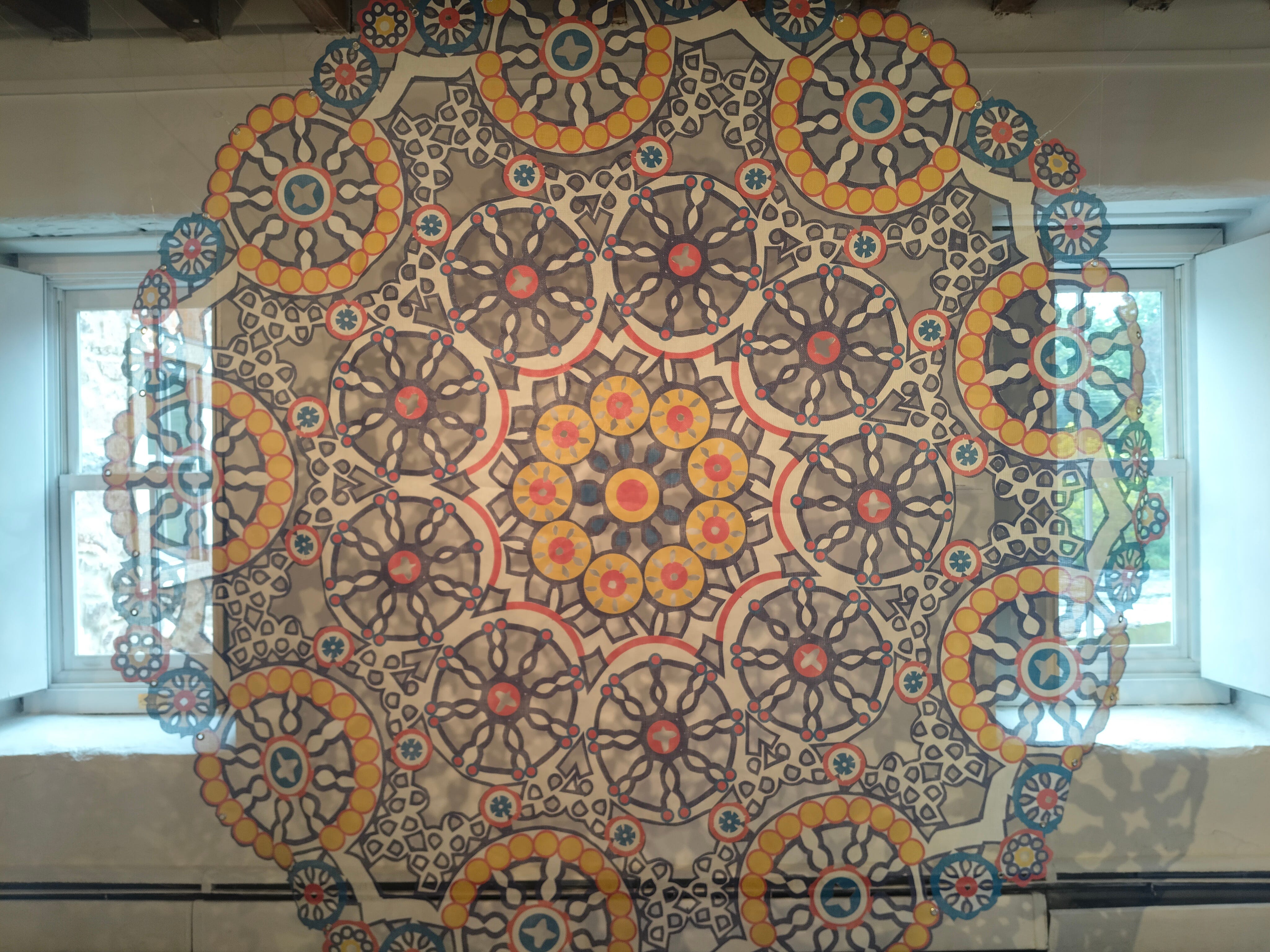
Among the artists brought together by Mattera, Jennifer Cecere has spent decades transforming materials and forms associated with textile and domestic work. The doily is a recurring motif in her practice, including at monumental scale: in A Legacy of Making she is showing one in nylon roughly eight feet in diameter, while in Double Doily, installed in the Financial District in 2013, she turned the same motif into a bench. In other works, doilies, lace, tea-towels, blankets, and other textile objects are stitched, assembled, and coated in layers of paint until the original objects become unrecognizable. The layering offers a concrete image of how diasporic identity is constructed: what is inherited is not always recognizable in its original form, but is incorporated into new forms alongside new languages, experiences, and senses of belonging.
Tradition is not an object that survives intact; it is a skill that shifts its medium, language, expressive form, and—inevitably—its meaning. That skill also carries an idea of work with it:: something one does that yields a tangible result, something visible. Christopher Castellani recalls growing up in a working-class family in which this tangibility held real weight. His cousins were masons: “You could see it. Like, I made that wall.” His mother was a seamstress who made drapes, his uncle a tailor, his aunt a butcher. Writing, by contrast, felt abstract: “Until I published a book, it was very hard for people in my family to understand exactly what I was doing.” The book finally made the work visible. Making, then, as a form of knowledge bound to the ability to leave a concrete trace. “The connection to Italy, to the culture, to the old country, runs through the things that were made,” says Mattera—a connection that becomes increasingly indirect with each passing generation. Art keeps it alive not simply by preserving the object that was made, but by reactivating the knowledge contained in the act of making it.
From Preservation to Production
The past continues to play a role in the present when it is put to use. It is in this sense that John Avelluto speaks of the need to shift Italian-American culture “from preservation to production.” Inherited traditions, artisanal practices, objects, and symbols are not merely things to be safeguarded, but materials with which to continue producing culture. It is their use—and thus their transformation—that keeps them relevant in the present.
This is the guiding principle behind PIACE (Progressive Italian American Cultural Exchange), a group founded by Avelluto specifically to create a space where the history, practices, and symbols of Italian-American culture can be studied, discussed, and—above all—put back into active use through new forms of cultural production. For Avelluto, this also relates to how a culture is lived and transmitted: putting cultural heritage to use means rescuing it from the status of a pre-packaged product. “In the United States, you are encouraged to move away from the means of labor and production. Even culturally, nowadays you have to buy the T-shirt to be Italian-American,” he says. Instead of participating in the production of one’s own culture, one simply buys it ready-made.
Avelluto’s alternative begins with the objects of heritage themselves: “”How can we continue to actively interact with the elements of our heritage, rather than treating them as finished objects?”” The point, he says, is “using those things as a means of self-expression.” Just as Avelluto reclaims stereotypes in his own work, PIACE organizes moments in which history, visual culture, and practices are shared and then reworked: “putting people together to make together.” If heritage equates to a pre-established repertoire—such as Columbus, the flag, food, festivals, and monuments—then identity is something possessed through consumption. But if it becomes material for production, it demands participation. Someone has to take it, alter it, use it, and risk producing something the previous generation might not immediately recognize. That is what happens in the works of A Legacy of Making: “I like to say that our grandparents would probably be very proud of us at what we’re doing, but they would be shocked at how we have put to use what they taught us,” Mattera says. Continuity is achieved through transformation.
Who Makes the Legacy
Between what is produced today and what will be recognized as heritage tomorrow lies a process of selecting what enters exhibitions, collections, and archives. Through these choices, museums, curators, and institutions help shape the image of a culture that will be passed down over time.
At the Museo Italo Americano in San Francisco, founded in 1978, this process is part of the institution’s own history. Sandra Bagnatori, now Executive Director, recalls that at the time Italians in the United States were still strongly associated with the Mafia, while Italian art was primarily identified with the Renaissance. Founder Giuliana Nardelli wanted to showcase contemporary Italian and Italian American production. Today the collection numbers about 900 works.
Curator Bianca Friundi acknowledges that deciding what counts as “Italian American art” remains difficult. The museum receives proposals, selects, and enters into dialogue with artists. “It’s not just a display of artwork,” she tells me. “We want to tell stories.” Through “the dialogue between the museum and the artist, we build a story together.” Ultimately, she says, “we decide together. We decide with the artist what story” to tell.
Curatorial work thus reveals itself for what it is: a form of cultural production in its own right. Choosing what enters a collection helps determine what a community will recognize as its own heritage in the future.
On Columbus as an identity symbol, the museum takes a cautious stance. While recognizing him as part of the identity heritage of a segment of the Italian American population, it does not view it as its role to declare him a positive or negative symbol. Friundi frames their mission differently: “to keep Italian and Italian-American identity, culture, and art alive for future generations.” Yet, keeping something alive implies choosing what to continue breathing life into. And when a symbol that has long held a central place in the public representation of Italian-American identity loses that centrality, the question becomes inevitable: what is chosen to be passed on in its place?
After Monuments
The most immediate response is to look for another figure capable of assuming the same symbolic role. There are many possible alternatives. Joanne Mattera mentions Francesca Cabrini and Ella Grasso. Sciorra helped bring attention back to figures from labor and radical history such as Carlo Tresca, Angela Bambace, and Pete Panto—who were virtually absent from the Italian-American monumental landscape. Avelluto addressed the question of monumental replacement through Antonio Meucci. He used his phone to scan the inventor’s death mask and brought his face to the fore in a work titled Can You Hear Me Now?. He was interested in the story of an immigrant whose work had never received full recognition as well as the complex interplay between Meucci, Bell, and the modern telephone. Yet even Avelluto ultimately questions the value of yet another hero: “I would move away from using a person,” he says, preferring objects, gestures, and symbols precisely because they are more fluid, changing as they move across contexts and generations.
The search for a replacement therefore calls into question the very premise of the monument itself: that a complex identity can be distilled into a single figure. Castellani shares this view: “I don’t think any historical figure should carry that kind of weight. There’s no way you can put an entire cultural experience on one person.” The complexity of diaspora lies precisely in the multitude of stories, affiliations, and transformations it encompasses.
In recent years, identity art has held a prominent place in American art, especially as a space of representation and reclamation for historically marginalized communities. Within this framework, the Italian-American experience occupies a more complex position. The history of discrimination is real, but so is Italian Americans’ later incorporation into whiteness, which profoundly changed their position in American society. This transformation is also part of the heritage; ignoring it would mean conveying an incomplete version of history.
That very ambivalence, however, makes the Italian American experience a useful lens through which to examine notions of identity built around rigid affiliations. The heritage that emerges from the work and experiences of contemporary Italian American cultural producers is shared, layered, and continually transformed. The heritage emerging from the works and experiences of contemporary Italian-American creatives is, by contrast, shared, layered, and constantly evolving. The doily changes material, scale, and function; a superstitious gesture crosses generations to become a global language; food shifts from stereotype to artistic medium; manual knowledge learned within the family resurfaces two generations later in a different form. The act of making becomes the site where these layers interact: what has been inherited meets new experiences, new languages, and new affiliations, continuing to generate culture.
Sciorra put it most clearly: “I’ve always said there is no single Italian American history or one Italian American experience. There are Italian American histories and experiences in the plural.” It is that plural that can be passed on to the future: a heritage that stays alive because it continues to be used, transformed, and produced. Within that plurality, Columbus returns to being one story among others, while identity continues to be a work in progress.